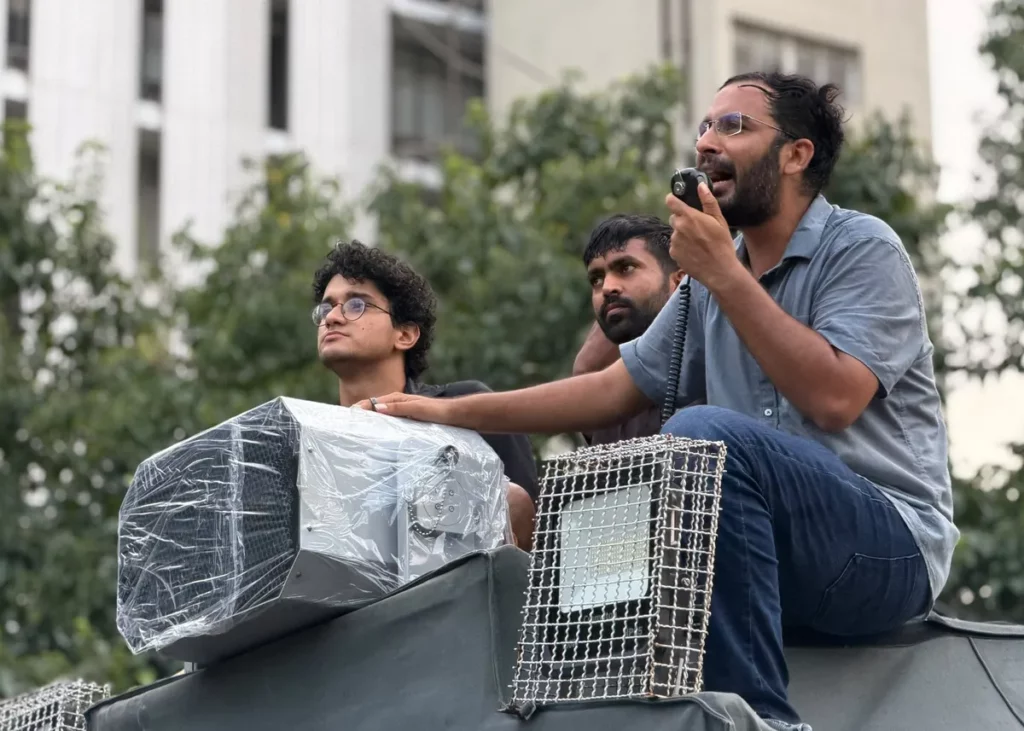
Saurav Das is an Indian investigative journalist, RTI activist, policy researcher, and political communicator based in New Delhi. Known for rigorous data-driven investigations into the judiciary, police accountability, and governance transparency, he became one of India’s most prominent voices for systemic reform. In June 2026, he was appointed Chief Spokesperson of the Cockroach Janta Party (CJP), a youth-led political movement demanding accountability on education and unemployment.
Table of Contents
Saurav Das Wiki-Bio
| Field | Details |
| Full Name | Saurav Das |
| Age | 26 Years |
| Date of Birth | 28 January 2000 |
| Profession | Investigative Journalist, RTI Activist |
| Current Role | Chief Spokesperson, Cockroach Janta Party (CJP) |
| Nationality | Indian |
| Religion | Hindu |
| Current City | New Delhi, India |
Education
| Field | Details |
| Degree | Bachelor’s in Journalism and Mass Communication |
Saurav Das Background
Saurav Das began engaging with investigative work during his college years, well before formally entering professional journalism. This early immersion in public accountability reporting established the foundational ethos of his career — a commitment to using statutory transparency tools as instruments of institutional scrutiny. He holds a degree in Journalism and Mass Communication, a qualification that shaped not only his reporting methodology but also his understanding of how information must be packaged and disseminated to force institutional responses.
His professional writing career formally began in 2020, though his RTI activism predates this, with documented use of India’s Right to Information Act from as early as 2017. He operates entirely from New Delhi, where he has built one of the most consequential independent investigative portfolios in contemporary Indian media.
Career
Saurav Das’s career is built around a dual-pronged model: he investigates state opacity through RTI filings and independent reporting, then takes the battle into the courts through public interest litigation when authorities resist disclosure. His bylines have appeared in The Caravan, Article 14, Al Jazeera, The Wire, The Hindu, and New Lines Magazine.
His most significant investigation, supported by a Pulitzer Center grant, examined extrajudicial police killings in Uttar Pradesh — filing over 40 RTI requests and analyzing more than 2,000 pages of National Human Rights Commission documents to expose how police falsified encounter narratives and rendered Supreme Court guidelines on shootouts effectively meaningless. Published in New Lines Magazine in August 2024, the investigation drew national attention and critical press coverage.
He also pursued a landmark transparency case regarding the Aarogya Setu contact-tracing app during COVID-19, filing RTI applications with MeitY, NIC, and NeGD after the government’s contradictory responses — including the NIC claiming it “does not hold information” about an app its own website credited it with building. When the Central Information Commission reversed course without a hearing, Das filed Writ Petition W.P.(C) 10873/2020 in the Delhi High Court, forcing judicial scrutiny onto the government’s digital health policy opacity. He also filed a PIL in the Supreme Court, represented by civil rights lawyer Prashant Bhushan, seeking public online access to police charge sheets — a case that reached the apex court and triggered a nationwide legal debate on open justice versus privacy, even as the court ultimately ruled against mandatory publication.
Additionally, Das co-founded the Climate Action Front (CAF), a think-tank focused on climate research and net-zero policy, where he serves as Policy Researcher alongside CEO Shubham Thakur. The organization works on Life Cycle Assessments, supply chain decarbonization, and regulatory compliance guidance. He has also appeared on the podcast That’s Her Podcast hosted by Neha, delivering a widely discussed breakdown of RTI erosion, judicial opacity, the Collegium system versus NJAC, post-retirement judge appointments, electoral integrity, and contempt of court weaponization.
In November 2025, Das co-led anti-pollution protests at India Gate in Delhi, which established his credibility as a public mobilizer before his formal entry into organized political activism.1
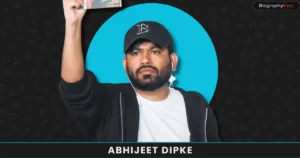
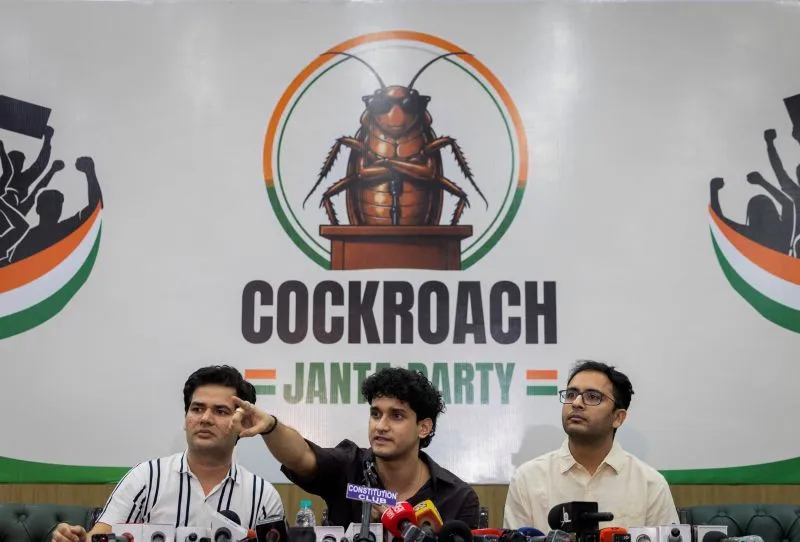
On June 2, 2026, he was appointed Chief Spokesperson of the Cockroach Janta Party, a movement founded by Abhijeet Dipke after Chief Justice of India Surya Kant allegedly compared unemployed youth to “cockroaches.” The party, which amassed over 22 million Instagram followers — surpassing both the BJP’s 9 million and the Congress’s 13 million on that platform — was transitioning from satirical digital campaign to organized political force. Das announced the appointment via X with the declaration: “Ab hum bolenge. Ab hum desh ka bhavishya khud likhenge!” (Now we will speak. Now we will write our country’s future ourselves.) He held a press conference on June 3 at the Constitution Club of India announcing a protest at Jantar Mantar on June 6, with demands focused on education reform and the resignation of Union Education Minister Dharmendra Pradhan over NEET exam leaks and student suicides.2
Some Lesser-Known Facts
- On his verified X profile, Das lists his philosophical influences as Bhagat Singh, Swami Vivekananda, Rosa Luxemburg, and Gautama Buddha — a deliberately eclectic combination that maps onto his practice: revolutionary anti-establishment confrontation, youth mobilization, mass-strike theory, and a commitment to non-violent civil dissent.
- He is recognized as a Thakur Foundation Awardee for in-depth reporting on India’s public health infrastructure — a grant that funded independent reporting entirely separate from his better-known RTI and police accountability work.
- When targeted by an online scam ring impersonating Mumbai Police officers, Das turned the extortion attempt into a public interest story — he outwitted the fraudsters by claiming notorious underworld don Dawood Ibrahim was his “chacha” (uncle), then published a detailed exposé on the psychological tactics of the fraud ring.
- Das personally secured and broadcast the video of a student being silenced mid-question during a public lecture attended by Chief Justice Surya Kant, posting it on X with the caption: “Big News! Chief Justice of India Surya Kant heckled. ‘Give us some respect please,’ a young student said!” — an act of citizen journalism that directly catalyzed mass enrollment into the CJP movement.
- The CJP’s maiden press conference was held at the Constitution Club of India, which requires a recommendation letter from a sitting MP to book. Das personally requested the letter from Rajya Sabha MP Prof. Manoj Jha of the RJD, whom he knew professionally — a disclosure he made publicly to prevent the recommendation from being misread as political backing, stating: “Any such linking is misleading and must be ignored.”
- In May 2026, just weeks before his CJP appointment, the Delhi High Court issued a contempt notice to Das in a case alleging he ran a “coordinated campaign” against Justice Swarana Kanta Sharma by reporting on alleged conflicts of interest during the Delhi excise policy case. Das refused to retract his reporting, stating: “I stand firmly by my reporting… Questions cannot be contempt.”
- On June 6, 2026, as Delhi Police deployed approximately 2,000 personnel in riot gear around Jantar Mantar, Das managed real-time crowd logistics via social media — including rerouting protesters away from Parliament Street Police Station directly to Jantar Mantar once permission was formally granted.
- The CJP’s 22 million Instagram followers represent a digital footprint more than twice the BJP’s presence on that platform — a metric Das and CJP leadership have cited to counter claims that the movement is fringe or foreign-backed.
- He successfully argued before the Central Information Commission that the NIC’s claim of not holding information about the Aarogya Setu app was “extremely preposterous,” winning show-cause notices against four Central Public Information Officers — though the CIC subsequently reversed course, prompting his High Court petition.
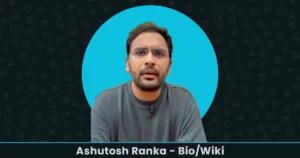
- The CJP spokesperson team was intentionally built as a triad of distinct strengths: Das (investigative credibility), Vijeta Dahiya (viral digital content; former researcher for YouTuber Dhruv Rathee), and Ashutosh Ranka (IIT Kanpur and London School of Economics alumnus; former McKinsey consultant in London who returned to India in 2025 to lead youth movements in Jaipur).

Also check these biography profiles: Palki Sharma, Sanket Upadhyay, Shefali Bagga, Abhijeet Dipke